The Real ROI of a Pick and Place Machine

The Real ROI of a Pick and Place Machine
- By: Will Li
- Published: February 22, 2026 |
Modified: August 11, 2026 - Estimated read time: 7 minutes
- By: Will Li
- Published: February 22, 2026 |
Modified: August 11, 2026 - Estimated read time: 7 minutes
Most teams evaluating a pick and place (PnP) machine default to two familiar comparisons: the sticker price of similar PnP machines and the per-board cost of outsourcing.
These benchmarks feel logical because they are easy to quantify, easy to justify, and easy to present in a budget conversation. But they are also the main reasons hardware teams dramatically underestimate both the hidden cost of their current workflows and the actual return of bringing assembly in-house.
Dispel the iceberg illusion
To understand the real economics of a pick and place machine, teams need a different mentality that captures both the direct and indirect impact a machine has on product development, engineering velocity, and the predictability of your pipeline.
This is where the concept of total cost of ownership (TCO) becomes essential. TCO is a financial estimate that accounts for all costs associated with the purchase, operation, and maintenance of a product or service across its lifecycle.
Visually, TCO is often represented by the iceberg analogy: the initial purchase price is the visible tip above the water, which most decision-makers focus on. However, this is only a small fraction of the true cost. The far more significant and frequently undermeasured hidden costs are the unseen underwater mass that determines the real financial impact over the long run.
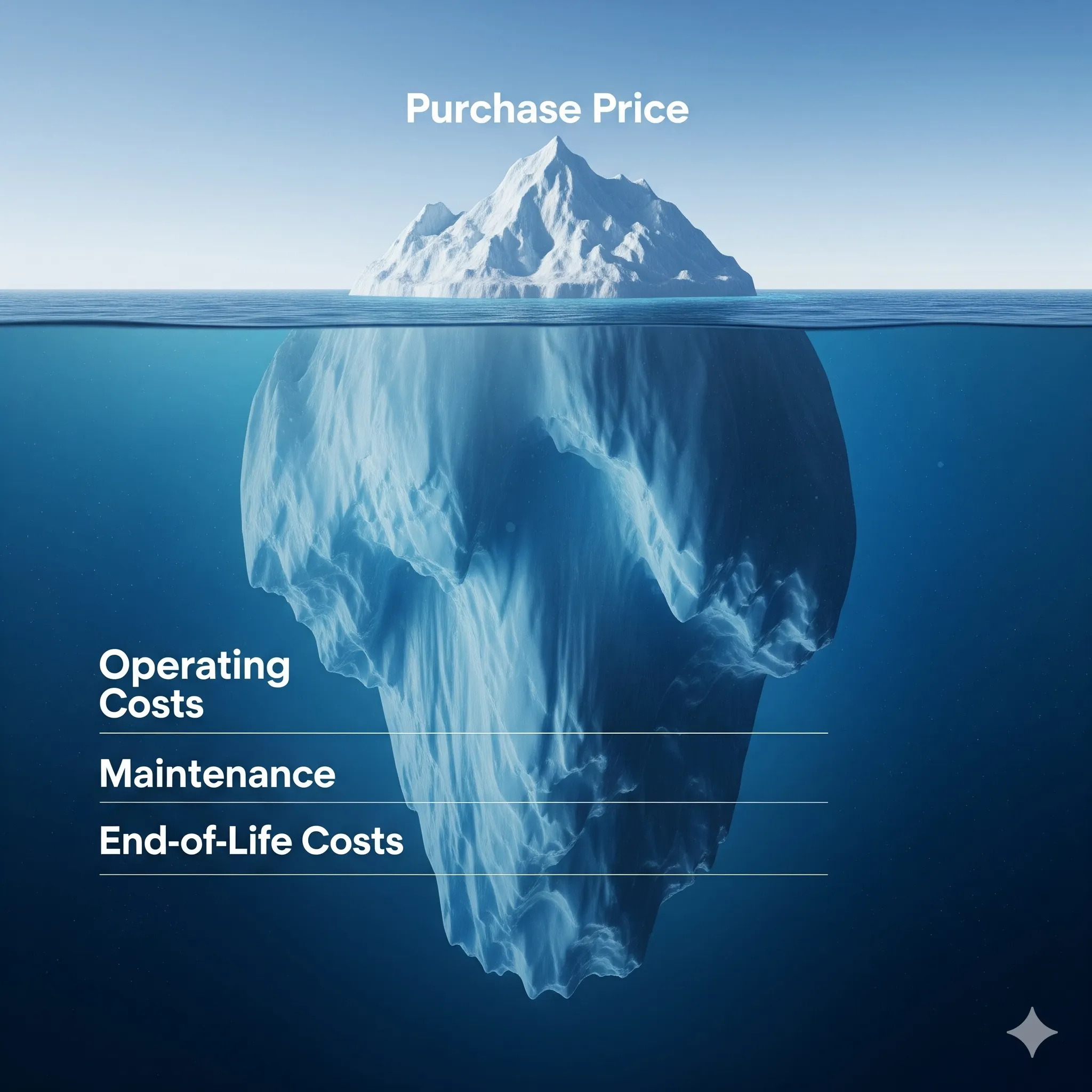
Recognizing TCO in the purchase evaluation ensures a complete view of costs, forming the basis for the real ROI framework for a pick and place machine:
Real ROI = (time-to-market advantage × uptime × reliability) ÷ total cost of ownership
This is not a literal equation, but a conceptual map. It reflects a simple truth:
These forces multiply one another. A weakness in any one of them drags the entire system down.
- A “fast” machine with poor reliability, producing faulty assemblies, delays.
- A “cheap” machine with low usability stays idle and becomes expensive over time.
- A machine with high “uptime” but no impact on iteration speed cannot accelerate development.
Once teams internalize this model, the flaws in the common sticker-price and outsourcing comparisons become clear.
Discover how Voltera is transforming PCB assembly with Alta, our new desktop pick and place machine designed to streamline in-house prototyping.Why traditional comparisons fail
1. Sticker price vs. similar machines
A several-thousand-dollar difference between comparable pick and place machines feels meaningful, but sticker price reveals nothing about the machine’s true usable output.
Lower-cost machines often bring higher setup friction, steeper learning curves, ambiguous workflows, and more downtime. Over the machine’s life, these frictions compound into lower utilization, unpredictable throughput, and a much higher amortized cost per board.
Sticker price is not cost. Sticker price is an invoice. Total cost of ownership (TCO) is the real cost.
2. Cost-per-board vs. outsourcing
Teams frequently reduce the ROI question to: “If outsourcing costs $10 a board, how many do we need to build internally to justify a PnP machine?”
On paper, this looks tidy. In practice, it ignores the dominant cost driver in hardware development: time.
Outsourcing introduces delays in communication, sourcing part supplies, shipping, and rework. Every delayed prototype stalls debugging, learning, and validation. Eventually, the ripple effect delays time to market. In agile hardware development, the cost of waiting is always higher than the cost of the invoice.
This brings us to the first multiplier in the ROI framework.
Time-to-market: The primary ROI multiplier
Time is the hidden currency in hardware development. Every delay in prototype turns, validation cycles, pilot builds, or field deployment directly shrinks a product’s revenue window. McKinsey’s research suggests that missing your launch window by just six months can wipe out a third of a product’s total potential profit.
This is the real cost of outsourcing builds or waiting for a complex machine to be set up properly.
In-house PCBA compresses iteration cycles from weeks to hours. Engineers can place, reflow, inspect, and optimize boards multiple times in a single day. Therefore, issues are discovered earlier, schedules stabilize, and risk decreases.
Our blog Why In-House PCB Assembly is the Next Leap for Agile Hardware Teams explores how board assembly decisions affect your time-to-market, which is the foundation of ROI thinking for modern hardware teams.
Usability drives uptime, uptime drives ROI
A pick and place machine does not generate value when it sits idle. And most idle machines aren’t idle because “there was no work to do”. In fact, they’re idle because the friction to use them is too high. In other words, they are not designed for usability.
Machines with unclear workflows, ambiguous job setup, and long changeover times push teams back toward manual placement or outsourcing. Even if a machine is theoretically fast, low usability means low utilization, and therefore low ROI.
This is why usability is not a “feature,” but an uptime engine. Conversely, machines with:
- Self-contained software and built-in workflow instructions
- Automatic board alignment that identifies location and orientation
- Component loading that requires minimal user intervention
- No manual setup for pick and place height, offset or rotation
- Fast job setup and minimal maintenance required
generate more usable hours per month.
From our market research, a prototyping engineer at a product design firm told us:
"Every board we build is different. 80% of the components are unique to that specific build, so the machine preparation and switch-overs easily drain a day." — Andre Van Rensburg, Engineer, M3SH Technology
Industry commentary, including 2025 perspectives from I-Connect007, emphasizes exactly that in high-mix environments, changeover time, feeder setup, machine uptime, and software usability often impact overall output more than raw placement speed CPH.
A machine’s ROI is driven by how often it’s used, not how fast it appears on paper.
Reliability: The hidden ROI multiplier
The final multiplier is reliability, a machine being accurate and repeatable. Every failed board is more than a wasted PCB but a lost opportunity for iteration and optimization: it delays testing, derails debugging, wastes engineering time, undermines schedule predictability, and creates excessive reworks that inflate true cost.
Vendors focus on repeatability and placement accuracy in spec sheets, but machine reliability is a complex metric determined by many factors:
- Is the vision system advanced enough for the minimum component size claimed?
- Can it detect assembly defects and provide instructions to fix them?
- Does it automatically detect Z-height and adjust placement depth?
- Is the equipment from an established manufacturer with proven hardware quality?
A long list of technical questions remains. To gain insight beyond the specifications, reviewing user demos from public sources, such as YouTube, is critical. True reliability is only determined in real-use scenarios.
Reliable performance reduces your TCO, amplifies ROI by enabling stable, predictable iteration cycles. This principle connects directly to What is PCBA, where we emphasize that repeatability is a core economic driver for in-house assembly.
Bringing it all together
Sticker price and cost-per-board calculations are convenient, but incomplete. The real economic impact of a PnP machine emerges only when teams view it through the full ROI framework:
Real ROI = (time-to-market advantage × uptime × reliability) ÷ TCO
This framework helps teams answer better questions:
- Does the machine meaningfully accelerate iteration cycles?
- Will our team actually use it every week?
- Can it deliver consistent results that reduce rework?
- How much downtime, retraining, or friction does the machine introduce?
- What is its real cost over years, not just on day one?
When selecting a pick and place machine, look beyond sticker prices and outsourcing quotes. Evaluate how time-to-market, uptime, and reliability interact to shape long-term economic performance. These three forces dictate whether a machine becomes a boost or a bottleneck.
Interested in learning more about PCB assembly? Check out these resources:
- Blogs:
Discover how Voltera is transforming PCB assembly with Voltera Alta, our new desktop pick and place machine designed to streamline in-house prototyping.
Check out our customer stories
Take a closer look at what our customers are doing in the industry.