Webinar Recap: Printing Sustainable E-Textiles
Webinar Recap: Printing Sustainable E-Textiles
- By: Shuxuan Jiang
- Published: March 26, 2026 |
Modified: April 17, 2026 - Estimated read time: 4 minutes
- By: Shuxuan Jiang
- Published: March 26, 2026 |
Modified: April 17, 2026 - Estimated read time: 4 minutes
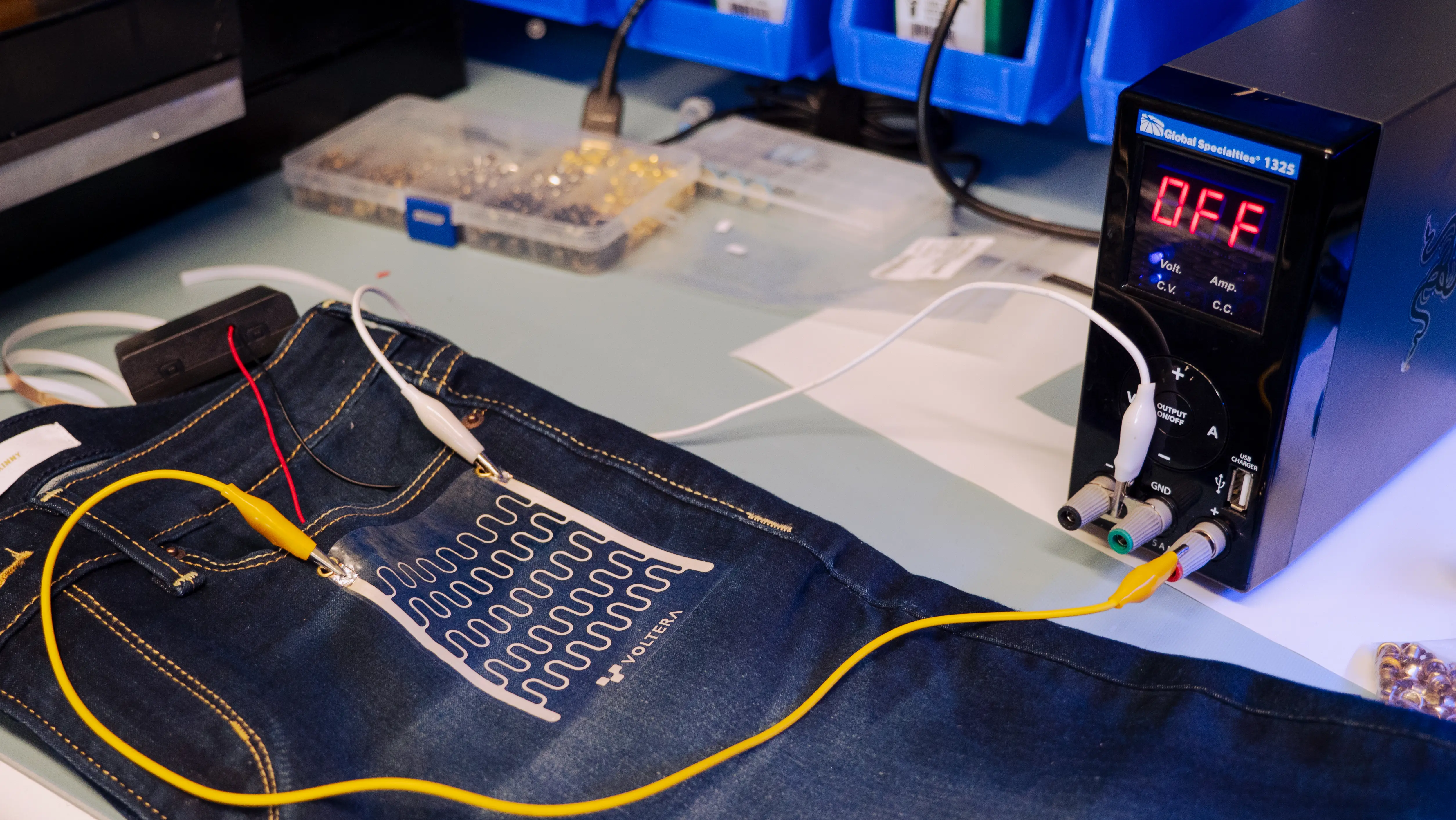
In this webinar, Dr. Marie O’Mahony, lecturer in textiles and e-textiles at the University of Southampton, and Thomas Pol, Product Manager at Voltera, talked about how sustainability needs to be built into e-textiles from the very beginning, from purpose and material selection to testing, user adoption, repair, and end-of-life strategy. The webinar also explored how additive printing can support faster prototyping on textiles, and how NOVA can be used to develop functional wearable concepts such as printed heated garments.
Webinar highlights
Wearable technology is rapidly growing
Tom opened the webinar with a brief overview of the wearable technology market, noting that wearables are no longer a niche category. The space is growing quickly, driven by smaller and lighter electronics, increasing interest in health and fitness tracking, and broader use of wearables in healthcare systems for at-home monitoring. E-textiles are becoming more relevant, but growth also brings more pressure to think seriously about sustainability and long-term impact.
Sustainability has to be built in from the start
Dr. Marie O’Mahony then focused on sustainability as a design challenge. She began by introducing her work at the Winchester School of Art, University of Southampton. She described the SUSTAIN project as a multi-year effort focused on how to move e-textiles from promising ideas into scalable, commercially relevant products while keeping sustainability central from the beginning. That includes thinking about circular manufacturing, reliability across the garment lifetime, repair, reuse, and controlled degradation rather than treating those issues as something to address at the end.
She also emphasized the scale of the waste challenge. With wearable technology growing quickly and e-waste already measured in tens of millions of tons globally, the field cannot afford to treat sustainability as optional. She outlined a broad set of issues that need to be considered, including value-chain accountability, regional and sector-specific legislation, manufacturing energy use, water impact, transport, packaging, longevity, end-of-life handling, and the need for new repair and reuse models.
Dr. O’Mahony then talked about the role of design. She argued that products with a clear purpose are more likely to be used, valued, maintained, and kept in circulation longer. Meaningful function and user benefit are closely tied to sustainability because they help prevent products from becoming short-lived novelties. As an example, she highlighted haptic garments created for hearing-impaired users, allowing them to experience concerts or football matches in a more embodied way.
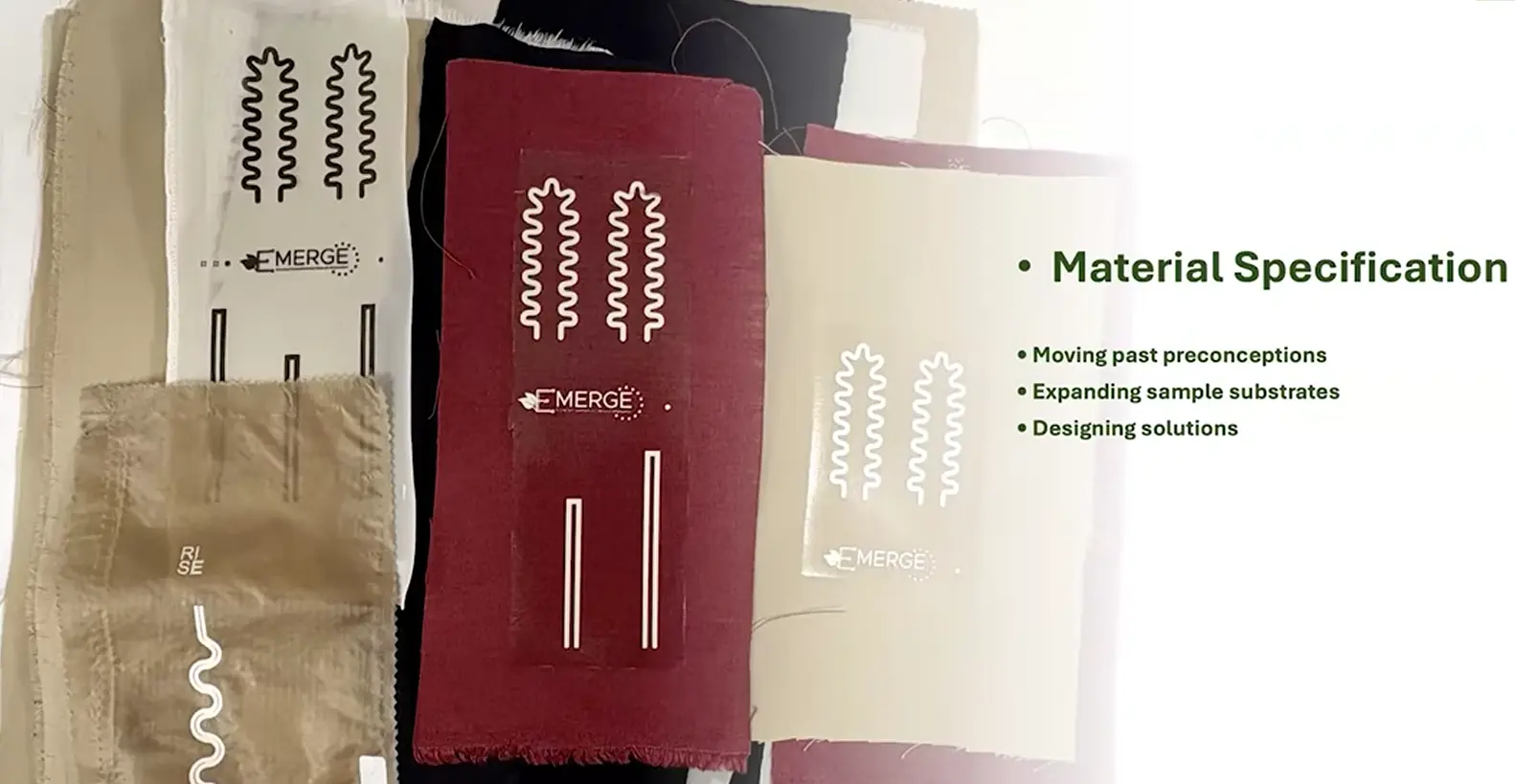
Dr. O’Mahony also discussed material testing and process development. She described trial work across different fabrics and printing methods, noting that results often depended on details that were easy to overlook. In some cases, even changing print direction relative to the weave affected conductivity. Her advice was to test throughout the process, document results carefully, and build a sample library that includes both successful and unsuccessful material combinations.
Prototyping e-textiles with NOVA
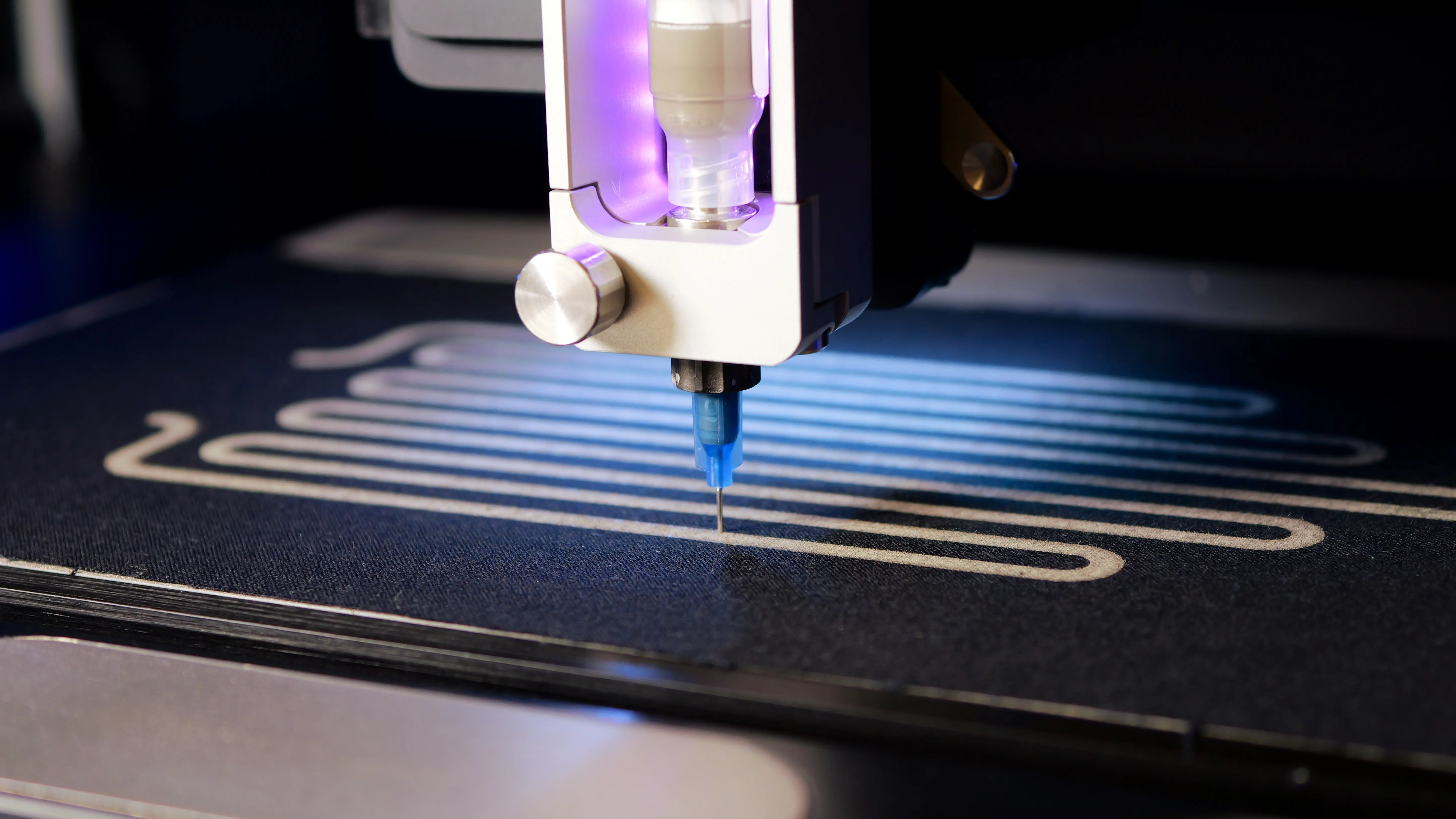
Next, Tom introduced Voltera’s NOVA materials dispensing system and its role in e-textile prototyping. NOVA supports screen printable materials, camera-assisted alignment, and multilayer printing, all of which are useful for high-quality flexible hybrid electronics applications. He then walked through a heated mitten project where conductive ink was dispensed onto cotton fabric to create a wearable heating element. To learn more about this project, check out this white paper.
Live Q&A
Q: What area of e-textiles has the most room for growth?
A: Health and well-being are the most exciting growth areas because they combine clear user needs with advances in miniaturized, conformable electronics. Notably, remote patient monitoring, elderly care, and digital health initiatives that allow people to leave hospitals sooner while still being monitored at home is a promising category.
Q: Are e-textiles fully recyclable today, and if so, how can textile and conductive materials be separated?
A: Not yet in a simple, universal way. Recyclability still depends heavily on the specific textile and ink system. While some promising directions are emerging, the field is not yet at a point where one can say there is a simple, fully recyclable solution ready for broad use.
Q: How do you improve washability and durability?
A: Dr. O’Mahony’s advice was to introduce wash testing early rather than waiting until a design appears finished, because products that look robust visually may fail quickly in even gentle wash conditions. Matching the ink to the textile, testing iteratively, and paying attention to subtle process details, such as print orientation relative to the fabric, all affect performance.
Q: What kinds of textile materials can be printed with NOVA, and what fabrics are recommended?
A: Tighter, flatter weaves are generally easier to work with, especially because they are easier to probe and map accurately. For the heated mitten project, a tight-weave cotton was used. Tightly woven materials such as ripstop nylon can also perform very well, and some synthetics, recycled polyesters, regenerated fibers, and TPU-based materials may offer smoother surfaces than cotton in printed electronics. Teams need to know exactly what fabrics they are testing, maintain records, and build a library of substrates and suppliers so successful results can be repeated.
Q: Have you designed printed sensors for vital sign monitoring, and what print resolution can NOVA achieve?
A: Yes, Voltera has designed a printed dry electrode for EKG monitoring. Details can be found in this white paper. NOVA can achieve print sizes down to about 100 microns depending on the material.
Q: Can textile-based printed electronics provide sufficient signal quality, stability, and biocompatibility for applications like EEG or ECG in clinical settings?
A: Yes. Dr. O’Mahony’s lab has been working with textile-based systems for exactly those kinds of applications. At the same time, achieving a good signal in a flat sample is only the first step. Real success also depends on garment design, sensor positioning, comfort, usability, and whether users can actually put the system on correctly and are willing to wear it consistently.
Additional resources
Interested in prototyping wearable devices using sustainable materials? Check out these resources:
- Video: Printing a Heated Glove on Cotton with Voltera NOVA
- Video: Printing PCBs on Biodegradable Substrates for End-of-Life Recovery
- Video: Printing ECG Electrodes with Gold Ink on Voltera NOVA
Ready to talk about how NOVA can help you prototype e-textiles? Book a meeting to speak with one of our technical representatives.
Check out our customer stories
Take a closer look at what our customers are doing in the industry.